


Table of Contents
After working with 50+ nonprofits across dozens of consultants, we have noticed something: the most effective strategic plans all share three traits. The struggling ones fail in countless different ways.
TL;DR
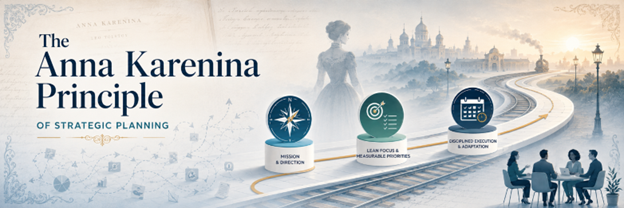
The most effective nonprofit strategic plans share three traits:
• They are grounded in mission and genuinely strategic, not just operational.
• They are lean and specific with clear ownership, focused on three to five priorities with clear measures of success.
• They include a disciplined execution rhythm that turns the plan into an ongoing conversation.
The first sentence of Anna Karenina (1877) is one of the most famous in literature:
"All happy families are alike; each unhappy family is unhappy in its own way."
Leo Tolstoy
That line has stuck with me since college, because it matches what I have seen across the families I have known. After working with dozens of consultants and nonprofits at StratSimple, I see the same pattern in strategic plans.
There are infinitely many ways to put together a less than effective strategic plan. The plan that lists 210 priorities for the next 12 months (yes, actually).The plan that says "improve fundraising" without a number attached. The plan that gets a beautiful binder and then sits on a shelf for three years while the team works on something else entirely. We have seen all of these, and many more.
The effective plans, on the other hand, share the same three traits.
Effective Strategic Plans Are Grounded in Mission
Good strategic planning starts with an aligned sense of where the organization is today and where it is going. The vocabulary varies across frameworks. Some consultants emphasize mission and vision. Others lead with values. Others frame everything around positioning. The labels matter less than the underlying questions every leadership team has to answer:
• Who do we serve?
• How do we serve them?
• What is the situation we are operating in?
• Where are we going?
• What needs to change to get us there?
In the nonprofit world, this is where the board serves one of its most precious roles. Setting the long-term vision, aspirations, and direction for where the organization is headed is what separates strategic planning from purely operational planning.
A real strategic plan should make someone in the room a little uncomfortable, because it commits to changing course from the status quo.
Effective Strategic Plans Are Lean and Specific
Strategy is the act of saying no to good ideas.
As with many things in life, being concise is hard. Pascal famously apologized for writing along letter, explaining that he did not have time to write a shorter one. That applies to strategic planning too. If organizations as large as Amazon and Walmart focus on three to five big things for a year, it is striking how many small nonprofits with small teams believe they can handle fifty.
The most effective organizations focus on the few most important goals over a three-year period. And then break that down to the few most important objectives each year (3-5 is a good target range). We have to help our teams stay focused on what matters most, because the plan only works if people can actually keep it in their heads.
For each of those goals, you have to be concrete upfront about what success looks like –and who is responsible for it. A goal to "improve at fundraising" is useless if no one knows whether the target is fifty thousand dollars or two million and who is responsible for it. We see this pattern regularly: the executive director thinks the goal is one number, the board chair thinks it is another, and the development team is working toward a third. Putting numbers on goals is uncomfortable. It makes us accountable. Without it, success or failure becomes a popularity contest at the end of the year. As Brené Brown says, "To be unclear is to be unkind."
Effective Strategic Plans Have a Disciplined Execution Process
This is the most intuitive trait on the list, and also the most commonly skipped. If we do not build a process to execute and adapt the plan, if we treat it as a static document, we may as well not have started.
What works best is a layered cadence:
• An annual planning rhythm that combines strategic and operational needs.
• Quarterly deep dives to reflect on what is working, what is not, and what adjustments are needed.
• Monthly team reviews to celebrate wins and identify where help is needed.
• Regular check-ins, often weekly, to share progress and obstacles as work moves forward.
The moment anew strategic plan gets signed off is the beginning of the strategic process, not the end. The real value of strategic planning lives in the conversations that happen about and around the plan. If your team is not talking about the plan regularly, using it day to day to shape their work, then what was the value of doing the plan in the first place?
The most common failure pattern here is the "binder on the shelf" plan. We have walked into nonprofits where the last strategic plan was three years old, no one on the current staff remembered who wrote it, and the goals had no obvious connection to anyone's day-to-day work. The plan was not bad. It just never got loved.
Happy Plans Are All Alike
Happy strategic plans, it turns out, really are all alike. They are grounded in mission, lean and specific, and built to be lived with rather than filed away.
Sincerely,
Mike
References and further reading
• Edwin A. Locke and Gary P. Latham, A Theory of Goal Setting and Task Performance.
jstor.org/stable/258875
• Nonprofit Strategy and Planning
https://boardsource.org/fundamental-topics-of-nonprofit-board-service/nonprofit-strategic-planning/
• National Council of Nonprofits
https://www.councilofnonprofits.org/running-nonprofit/strategic-planning-nonprofits
• Cambridge University Press
https://www.cambridge.org/core/journals/behavioral-and-brain-sciences/article/magical-number-4-in-shortterm-memory-a-reconsideration-of-mental-storage-capacity/44023F1147D4A1D44BDC0AD226838496
.png)