
The critical human element of facilitation
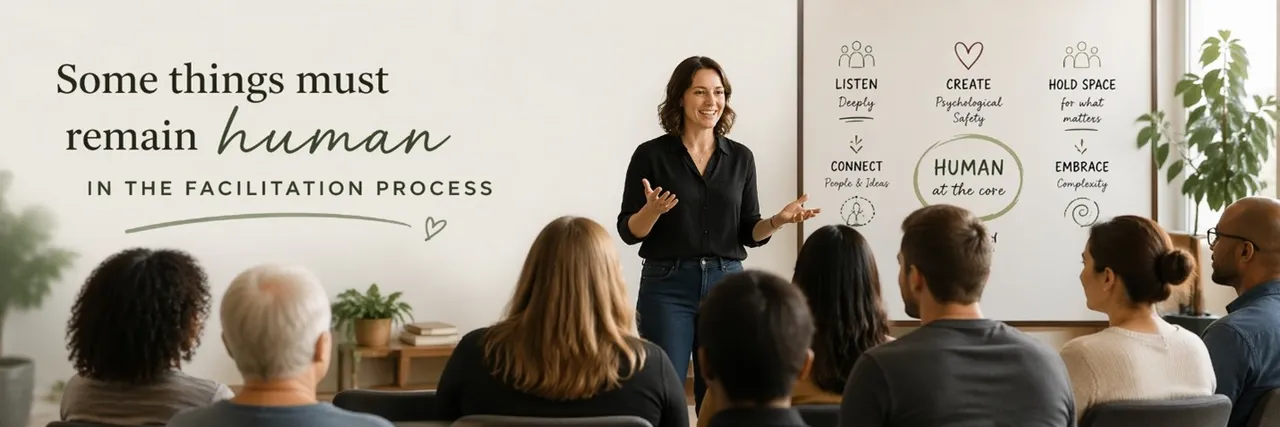
What almost 100 professional facilitators said about where AI belongs in their work, and where it doesn’t.
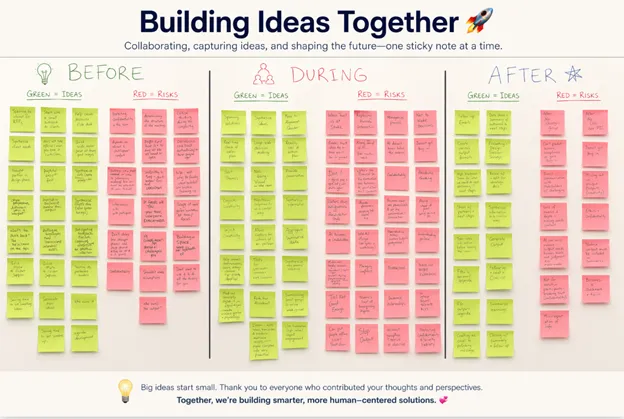
I had the pleasure of leading a workshop at the first annual Mid-Atlantic Facilitators Network conference last week. The prompt for the room: shift the conversation from “what CAN AI do?” to “what SHOULD AI do?” Nearly 100 facilitators showed up and generated almost 200 ideas about where AI helps their work and where it gets in the way.
Honest admission: I walked in a little nervous. These are the people we partner with at StratSimple. If a room full of potential partners told me they didn’t want AI anywhere near their work, that would be a real problem for our business.
Here’s what the room said:
- 56% support AI use before facilitation
- 50% support AI use during facilitation
- 58% support AI use after facilitation
Feels like a coin flip. It isn’t, really. The interesting part is where the green sticky notes ended up versus the red ones, because that tells you how working facilitators actually think about this. They’re not on the fence. They’re particular.
What AI is actually good for:
· Synthesis and pattern-finding is where AI earns its keep. Pulling themes from interviews and RFPs before a session, sorting live input during, and clustering notes afterward. This was the single biggest use case facilitators named.
· First drafts get faster at every stage. Slide decks and feedback forms before, strawmen and prompts during, recap emails and after-action reports after the actual facilitated event. The facilitator still shapes the final product, but the blank page goes away.
· A “thought partner” sharpens the plan. AI can play devil’s advocate, surface blind spots, anticipate pushback, and offer alternate interpretations before a facilitator walks into the room.
· Rote work stops eating prep time. Flip-chart-to-report, polishing communications, tightening alignment docs. Time saved here is time redirected to the human work that actually needs a human.
· Inclusion and accessibility widen the room. Live translation, capturing live meeting notes, connecting breakout groups, and tailoring language to each audience’s role or industry afterward. More voices get in, and more of them get heard.
Where AI has to stay out of the way:
· Trust is built by humans, not machines. Participants get less honest when AI is visible in the room, and no algorithm can produce the buy-in that comes from human-led consensus. The relationship between facilitator and participant is the thing doing the work.
· Nuance and context need a human filter. AI has no somatic sense and can’t read cultural or political subtext. It flattens unique voices, which is exactly what facilitation exists to surface. Human judgment has to sit between pattern-finding and any decision that matters.
· Diversity of thought needs protection from the echo chamber. AI can homogenize inputs before a session, dilute a facilitator’s style during, and deliver sameness after. The richness of the room gets preserved when humans shape the questions and curate what gets surfaced.
· Judgment is what clients pay for, so it can’t atrophy. If facilitators skip the prep or ship AI-drafted reports unreviewed, clients lose the expertise they hired. AI should amplify the work, not replace the thinking.
· Confidentiality and data ownership are non-negotiable. When AI is involved, who owns the output, how PII is handled, how proprietary client information is protected? These are important questions at every stage, and responsible tools answer them clearly.
The question we ended on
Last exercise of the day: as AI keeps getting more capable, what is the one thing in your practice that must stay human? Five themes emerged:
Human Connection & Trust Building – 31%
The facilitator creates authentic human connections and builds trust through personal rapport, making participants feel heard, seen and valued. Physical presence enables meaningful handshakes, hugs and the sense that another human genuinely cares.
Real-time Facilitation & Adaptation – 29%
The facilitator guides group processes dynamically, pivoting agendas based on emerging needs and facilitating actual conversations between participants. This includes asking powerful questions that deepen thinking and managing the messy, complex human interactions.
**Emotional Intelligence & Reading the Room – 26%
**The facilitator reads body language, senses unspoken dynamics, and responds to subtle emotional shifts in real-time. This includes understanding non-verbal cues, managing group emotions, and holding space for difficult feelings or trauma.
**Human Decision-Making & Accountability – 13%
**The facilitator ensures humans make final decisions and take responsibility for outcomes. While AI can assist with synthesis and ideas, humans must judge what moves forward and confirm genuine consensus.
**Designing the Session - 10%
**The facilitator partners with clients to design the engagement and then guides the group through it in real time. Pre-session work, reviewing the design, shaping the agenda, deciding what’s appropriate for this group, belongs to the human.
What I took away
I went in nervous. I came out excited.
The facilitators in that room weren’t worried about AI replacing them. They were worried about other facilitators using AI better and outcompeting them. They were protecting the specific parts of their work that actually are the work. Building trust. Pivoting in real time. Reading the room. Owning the decision.
That’s the same line we try to draw at StratSimple. AI for the survey synthesis, the draft decks, the progress reports, the stuff that eats prep time without paying anyone back. Not for the facilitator, the decision, or the judgment call about what this particular group needs right now.
If you’re a facilitator who was in that room: thank you. You confirmed the line we’ve been drawing at StratSimple is the right one, and you sharpened where it sits.
P.S. – if you want the detailed notes on all of the sticky notes, they are written up here.