
Research brief
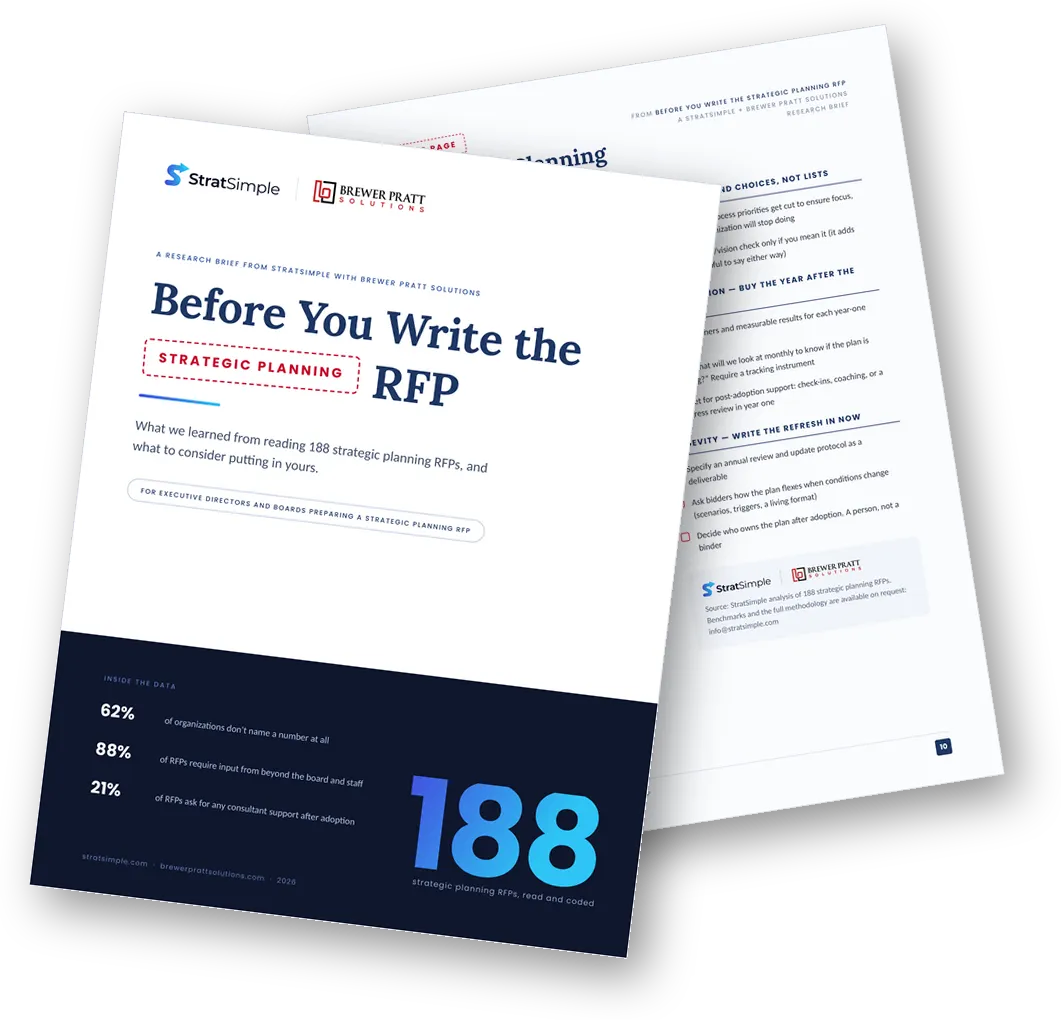
Before You Write the Strategic Planning RFP
What we learned from reading 188 strategic planning RFPs, and what to consider putting in yours.
Get the free guide
Inside the Research Brief
We read 188 strategic planning RFPs from nonprofits, associations, foundations, and public agencies, and coded what each one asked for: budgets, timelines, who had to be engaged and how, and what the consultant delivered.
The ten most useful findings are on this page, with the charts. The free PDF adds:
- The Strategic Planning RFP Checklist: 19 items to work from as you draft
- All the copy-ready RFP language in one place
- A print-ready version to share with your board
Who It’s For
Executive directors and boards preparing a strategic planning RFP. Written by StratSimple with Brewer Pratt Solutions.
Inside the data
- 188strategic planning RFPs, read and coded
- 62%of organizations don't name a budget at all
- 88%of RFPs require input from beyond the board and staff
- 21%of RFPs ask for any consultant support after adoption
The findings
10 findings from 188 strategic planning RFPs
We read 188 requests for proposals for strategic planning services, issued by nonprofits, associations, foundations, and public agencies, two-thirds of them since the start of 2024. Then we coded what each one actually asked for: budgets, timelines, who had to be engaged and how, and what the consultant delivered. When these organizations explain why they're going to market, an expiring plan and a leadership transition are the reasons they give most.
-
The typical RFP gives bidders about four weeks, expects a six-month process, and buys a plan meant to last three to five years
Across the 188 RFPs, proposals are usually due about four weeks after release. The planning process is expected to run about six months, and the finished plan is meant to last three to five years.
- ~4 wks from RFP release to proposals due
- ~6 mos expected length of the planning process
- 3 to 5 yrs how long the plan is meant to last
-
Five years is still the default horizon, but a third of organizations now ask for three-year plans
Of the 159 RFPs that specify a planning horizon, 61% want a five-year plan and 32% want a three-year plan. Nobody announced this shift; it just shows up in the data.
How long a plan do organizations buy? Share of the 159 RFPs that specify a planning horizon Item Share 5-year plan 61% 3-year plan 32% 4-year plan 4% Other 3% Source: StratSimple analysis of 188 strategic planning RFPs
If your last plan spent its final two years being politely ignored, you're allowed to plan shorter. Research from BoardSource points the same way: shorter strategic time frames and more adaptive planning are where the sector is going, because the world is moving too fast to plan too far into the future.
-
62% of RFPs don't name a budget. When they do, the median ceiling is $33,000
Budgets are where the data goes quiet. Among the 71 RFPs that disclose a budget ceiling, the median is $33,000, and the middle half of the market falls between $20,000 and $50,000.
Where budgets land when RFPs name one Share of the 71 RFPs that disclosed a budget ceiling · median $33,000 Item Share Under $20K 21% $20K–$35K 30% $35K–$50K 15% $50K–$100K 23% $100K+ 11% Source: StratSimple analysis of 188 strategic planning RFPs
Should you disclose your budget? Usually, yes. Naming a range doesn't hurt your negotiating position. What it does is filter out mismatched bidders and save everyone a round of discovery calls. Stay silent and you'll get proposals from less experienced $15,000 solo practitioners and $150,000 firms in the same pile.
One caution on the medians: disclosed budgets skew toward smaller, tightly scoped engagements. A process with deep stakeholder engagement and real support in year one prices above these numbers, and is usually worth it.
-
Price usually carries only about a fifth of the score, and four in five RFPs want sector experience
Nearly three-quarters of issuers publish their evaluation criteria. When price is scored, it usually carries about a fifth of the total. Four in five want a consultant who has done this work in their sector before.
- ~3 in 4 publish their evaluation criteria
- ~1/5 of the total score, usually carried by price
- 4 in 5 want a consultant with experience in their sector
If you're writing one, publish your evaluation criteria and their weights, and ask for sector-relevant experience and references.
-
88% of RFPs require input from beyond the board and staff
It's the most consistent demand in all 188 documents. The typical RFP names four distinct stakeholder groups, such as members, sponsors, partners, staff, and board members. Broad listening is no longer a differentiator; it's expected.
- 88% require input from beyond the board and staff
- 4 stakeholder groups named by the typical RFP
-
Fewer than one RFP in ten sets a participation target. When one does, the median is 37 people
RFPs are specific about who must be heard and strikingly silent about how many. Only 6% ask for engagement in more than one language. And the methods requested (one-on-one interviews, focus groups, a board retreat) often cap out at a few dozen voices, no matter how skilled the consultant running them.
- <1 in 10 state any participation target
- 37 median participation target, when one is stated
- 6% ask for engagement in more than one language
That's the input gap: breadth of stakeholders without scale of participation. An organization with 5,000 members commissions a process that will hear from forty people, then wonders why the broader community doesn't feel attached to the plan. People will show up for what they helped build.
“Uncover things we might not know we don't know”
From a community media center's RFP You can close the gap with one sentence. Name a participation target and make every bidder explain how they'll reach it; the quality of that answer will tell you more than any slide deck. None of this is an argument against experienced facilitators. Scale gets voices in the room; it takes a skilled consultant to turn what they say into hard choices.
Copy this into your RFP
“We expect at least XX% of our members, representative of our segments, to have a meaningful opportunity to contribute.”
-
73% of RFPs require measurable goals, but only 58% ask the process to prioritize
Most RFPs ask for the right artifacts of clarity. 73% require measurable goals or KPIs, and about two-thirds include a mission and vision refresh or want a SWOT or environmental scan. But only 58% ask the process to prioritize: to focus, to sequence, to decide what the organization will stop doing. Four in ten RFPs never ask for choices at all, and choices are the thing a strategy is actually for.
- 73% require measurable goals or KPIs
- ~2/3 include a mission and vision refresh
- 58% ask the process to prioritize
Too often, a plan with twelve co-equal priorities is a to-do list with a cover page. In your RFP, ask bidders to describe the moment in their process where priorities get cut, not just set. If the methodology has no such moment, the plan will have no such discipline.
A question you want to hear
“In year one, what are the five things the organization must get done — not five per goal, five total.”
-
The implementation cliff: 73% of RFPs buy a roadmap, but only 21% buy any help using it
This is the finding that made us write the brief. Track what RFPs require as the work moves from planning toward execution:
The implementation cliff Share of 188 strategic planning RFPs that ask for each element Item Share Implementation roadmap in the plan 73% A process to track progress on goals 58% Named owners accountable for goals 27% Any consultant support after adoption 21% A dashboard or tool to see progress 16% Source: StratSimple analysis of 188 strategic planning RFPs
Only one in six RFPs asks for any instrument, a dashboard or scorecard of any kind, that would let leadership see progress after the retreat is done. In the typical engagement, everything ends the day the board votes. The plan is adopted, celebrated, and archived in the same month.
Half of the RFPs reference a prior plan, and the candid ones are sobering. One organization admits its last plan “was not seen to fruition due to staffing changes.” Others describe bridge plans, COVID pivots, and position statements untouched for a decade. None of these plans failed at the writing stage. They failed later, quietly, in the year after the applause.
“The strategic vision and plan did not sit on a shelf”
From a foundation's RFP, notable because it felt the need to say so Here's the easiest win we found, and it costs one paragraph in your RFP. Ask every bidder:
Copy this into your RFP
“What happens after board approval? What will we be looking at, monthly, to know whether the plan is working, and what is your role in the first year of execution?”
Then budget for the answer. A plan with a progress rhythm, with named owners and metrics someone actually looks at, is a different product from a plan without one. The difference in cost is small. The difference in outcome is the whole game.
-
Associations trail the wider nonprofit sector on every implementation ask
63% of association RFPs require a roadmap (vs. 73% of all 188 RFPs), 50% ask for ongoing tracking (vs. 58%), and just 13% ask for any tracking tool.
Implementation asks: associations vs. all RFPs Share of RFPs that ask for each element Item Associations All 188 RFPs Require a roadmap 63% 73% Ongoing tracking 50% 58% Source: StratSimple analysis of 188 strategic planning RFPs
For volunteer-governed organizations, where board and committee seats turn over every year, execution machinery is how the plan survives its third leadership transition.
-
Only 16% of RFPs specify any refresh or review cadence for the new plan
Most RFPs treat the plan as a finished object rather than a living one. Only 16% specify any refresh or review cadence for the new plan: not an annual review, not a mid-cycle update, nothing. Just 20% use adaptive language of any kind (scenario planning, flexibility, a plan designed to bend), though that share is growing.
- 16% specify any refresh or review cadence
- 20% use adaptive language of any kind
The fix, again, is cheap: write the refresh into the RFP. Ask for an annual review protocol as a deliverable. Ask bidders how the plan should bend when the environment does. The 16% of organizations that ask for this are, not coincidentally, the ones describing their previous plans in the present tense.
What the best RFPs have in common
The strongest RFPs in our stack weren't the longest or the most formal. Each of these is a sentence or two in your draft:
- They named a budget range and a realistic timeline.
- They set a participation target instead of just listing stakeholders.
- They demanded real prioritization.
- They planned to keep the plan relevant from day one.
Get the full brief and the one-page RFP checklist
The free PDF has every benchmark on this page in a print-ready format to share with your board, plus The Strategic Planning RFP Checklist: 19 items across scope, input, priorities, implementation, and longevity to work from as you draft.
Get the free guideQuick answers
How much do nonprofits budget for a strategic planning consultant?
In StratSimple's analysis of 188 strategic planning RFPs, 62% didn't name a budget. Among the 71 that disclosed a budget ceiling, the median was $33,000, and the middle half fell between $20,000 and $50,000. A process with deep stakeholder engagement and real support in the first year of implementation usually prices above these numbers.
How long does a strategic planning process take?
The typical strategic planning RFP expects the process to run about six months, and gives consultants about four weeks from the RFP's release to submit proposals.
How long should a strategic plan last?
Five years is still the most common horizon: 61% of the RFPs that specify one want a five-year plan. But 32% now ask for three-year plans, and research from BoardSource points toward shorter time frames and more adaptive planning.
Should you include a budget in a strategic planning RFP?
Usually, yes. Naming a range doesn't hurt your negotiating position. It filters out mismatched bidders and saves everyone a round of discovery calls. Without one, expect proposals from $15,000 solo practitioners and $150,000 firms in the same pile.
What should a strategic planning RFP include?
Beyond scope and logistics, the strongest RFPs name a budget range and a realistic timeline, set a participation target for stakeholder input, ask where in the process priorities get cut, require named owners and a way to track progress after the plan is adopted, and write an annual review into the deliverables.
About this research
This research brief is based on StratSimple's analysis of 188 publicly issued requests for proposals for strategic planning services, from nonprofits, associations, foundations, and public agencies. Two-thirds were issued since the start of 2024. Each RFP was coded for budgets, timelines, who had to be engaged and how, and what the consultant delivered. Benchmarks and the full methodology are available on request: info@stratsimple.com.
With thanks to Elisa Pratt, MA, CAE, CVF of Brewer Pratt Solutions for her practitioner review and contributions to the RFP library behind this research.
StratSimple helps nonprofits and associations build strategic plans that get used, combining broad stakeholder listening, pairing clients with tested expert facilitation partners, and shared progress tracking so the plan survives long after the board vote.
Sources
- BoardSource: Nonprofit Strategic Planning
- Community Tool Box (University of Kansas): Identifying and Analyzing Stakeholders and Their Interests
- Strategy Magazine, Issue 40: Strategic Planning in Nonprofits: Evidence-Based Answers